Feminizing Hormone Therapy
A comprehensive guide for prescribing and monitoring feminizing hormone therapy.
The goal of hormone therapy in transfeminine patients is to reduce the endogenous effects of testosterone, such as coarse body and facial hair, and to induce feminine secondary sex characteristics, such as breast and hip development, in keeping with the patient’s individual goals. Physiologically, this requires suppression of endogenous androgens and the addition of estrogen.
Scroll through the information below, use the buttons on the left to jump to a section, or download reference the full Guidelines.
Hormonal Agents
A comprehensive overview of feminizing hormone therapy, including hormonal agents, formulations, and recommended doses.
Expected Effects of Combined Therapy
Keep in mind: hormone therapy results in both reversible and irreversible feminization.
The degree and rate of physical effects are largely dependent on patient-specific factors such as age, genetics, body habitus and lifestyle, and to some extent the dose and route used (selected in accordance with a patient’s specific goals and risk profile). Physical changes related to androgen blockade and estrogen may take months to appear and are generally considered to be complete after 2-3 years on hormone therapy.
Breast growth is an aspect of feminization to which many transfeminine patients often assign great importance. The degree of breast development is dependent on many factors, but most transfeminine patients experience modest breast development (average cup size < A, or developmental Tanner stage 2 to 3).4 In early studies, neither type nor dosage of estrogen was shown to affect final breast size, and no relationship between serum estradiol levels and breast development was found.4,5
Feminizing therapy does not affect the pitch of the voice in transfeminine patients. Some patients may obtain benefit from voice therapy with a qualified and supportive speech and language therapist who can work with the patient to modify their vocal characteristics. There are also a variety of surgical techniques (not covered by OHIP) that have been utilized to feminize the voice through alteration of the vocal cords.
Effects and Expected Time Course
Hover over the diagram to view information on the reversibility, expected onset and maximum effects of physical changes.1
|
Physical Effects
|
Onset
|
Max. Effect
|
Reversiblity |
|---|---|---|---|
|
Softening of skin/decreased oiliness |
3-6 months |
Unknown |
Reversible |
|
Thinned or slowed growth of body/facial hair |
6-12 months |
> 3 years |
Reversible |
|
Scalp hair loss (loss stops, no regrowth) |
1-3 months |
Variable |
Reversible |
|
Decreased muscle mass/strength |
3-6 months |
1-2 years |
Reversible |
|
Breast growth |
3-6 months |
1-2 years |
Irreversible |
|
Body fat redistribution |
3-6 months |
2-3 years |
Variable |
|
Decreased testicular volume |
3-6 months |
2-3 years |
Variable |
|
Decreased libido |
1-3 months |
3-6 months |
Variable |
|
Decreased spontaneous erections |
1-3 months |
3-6 months |
Variable |
|
Decreased sperm production |
Unknown |
> 3 years |
Variable |
|
Reduced erectile function |
Unknown |
> 3 years |
Variable |
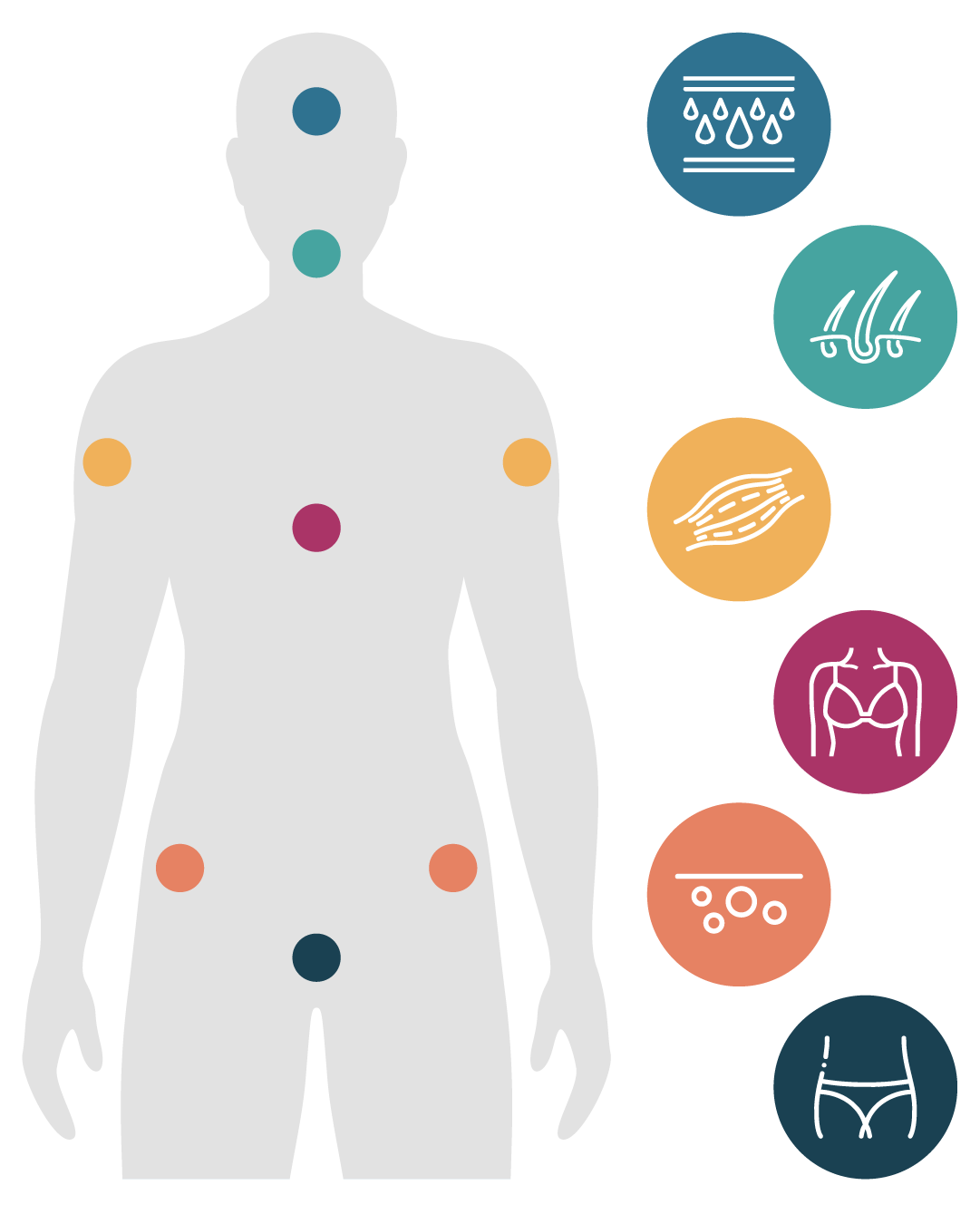
Skin Changes
Skin becomes softer and less oily; acne may decrease
Reversibility: Reversible
Expected Onset: 3 - 6 months
Expected Max. Effect: Unknown
Skin Changes
Skin becomes softer and less oily; acne may decrease
Reversibility: Reversible
Expected Onset: 3 - 6 months
Expected Max. Effect: Unknown
Hair Changes
Thinned or slowed growth of facial and body hair. Note: the complete removal of facial and body hair requires electrolysis, laser treatment, or both.
Reversibility: Reversible
Expected Onset: 6 - 12 months
Expected Max. Effect: >3 years
Scalp hair loss stops progressing, no regrowth.
Reversibility: Reversible
Expected Onset: 1 - 3 months
Expected Max. Effect: Variable
Hair Changes
Thinned or slowed growth of facial and body hair. Note: the complete removal of facial and body hair requires electrolysis, laser treatment, or both.
Reversibility: Reversible
Expected Onset: 6 - 12 months
Expected Max. Effect: >3 years
Scalp hair loss stops progressing, no regrowth.
Reversibility: Reversible
Expected Onset: 1 - 3 months
Expected Max. Effect: Variable
Decreased Muscle Mass and Strength
Reduction in muscle mass and strength; significantly dependent on the amount of exercise.
Reversibility: Reversible
Expected Onset: 3–6 months
Expected Max. Effect: 1–2 years
Decreased Muscle Mass and Strength
Reduction in muscle mass and strength; significantly dependent on the amount of exercise.
Reversibility: Reversible
Expected Onset: 3–6 months
Expected Max. Effect: 1–2 years
Decreased Muscle Mass and Strength
Reduction in muscle mass and strength; significantly dependent on the amount of exercise.
Reversibility: Reversible
Expected Onset: 3–6 months
Expected Max. Effect: 1–2 years
Breast Growth
Reversibility: Irreversible
Expected Onset: 3 - 6 months
Expected Max. Effect: 1 - 2 years
Breast Growth
Reversibility: Irreversible
Expected Onset: 3 - 6 months
Expected Max. Effect: 1 - 2 years
Body Fat Redistribution
Fat redistributes from abdomen and mid-section regions to the buttocks, hips and thighs.
Reversibility: Reversible/Variable
Expected Onset: 3 - 6 months
Expected Max. Effect: 2 - 3 years
Body Fat Redistribution
Fat redistributes from abdomen and mid-section regions to the buttocks, hips and thighs.
Reversibility: Reversible/Variable
Expected Onset: 3 - 6 months
Expected Max. Effect: 2 - 3 years
Body Fat Redistribution
Fat redistributes from abdomen and mid-section regions to the buttocks, hips and thighs.
Reversibility: Reversible/Variable
Expected Onset: 3 - 6 months
Expected Max. Effect: 2 - 3 years
Reproductive and Sexual Health
The reversibility of the following effects is variable. Decreased sperm production (infertility) as well as reduced erectile function may also occur.
Decreased Testicular Volume
Expected Onset: 3–6 months
Expected Max. Effect: 2–3 years
Decreased Libido
Expected Onset: 1–3 months
Expected Max. Effect: 3–6 months
Decreased Spontaneous Erections
Expected Onset: 1–3 months
Expected Max. Effect: 3–6 months
Reproductive and Sexual Health
The reversibility of the following effects is variable. Decreased sperm production (infertility) as well as reduced erectile function may also occur.
Decreased Testicular Volume
Expected Onset: 3–6 months
Expected Max. Effect: 2–3 years
Decreased Libido
Expected Onset: 1–3 months
Expected Max. Effect: 3–6 months
Decreased Spontaneous Erections
Expected Onset: 1–3 months
Expected Max. Effect: 3–6 months
Risk Mitigation
Pre-existing medical conditions and risk factors may impart increased risks with estrogen administration and should be considered in order to enable individualized discussions with patients regarding their unique risks and benefits of treatment. Available measures to reduce associated risks should be considered and discussed with patients and, if possible, undertaken prior to or concurrently with the initiation of hormone therapy.
Contraindications
- Unstable ischemic cardiovascular disease
- Estrogen-dependent cancer
- End stage chronic liver disease
- Psychiatric conditions which limit the ability to provide informed consent
- Hypersensitivity to one of the components of the formulation
Harm Reduction
In many cases, denying access to hormones can do much more harm than the possible risk of treatment. With an informed consent approach (support, information, education and consent) many providers will initiate hormones with individuals with higher risk profiles when it increases their quality of life/chance survival greatly.
Neurologic
Precautions in red impart moderate to high risk of an adverse outcome without risk mitigation. For more information on seizure disorders and anticonvulsant therapy, consult the Guidelines.
|
Risk Factors
|
How to Minimize Risks
|
|---|---|
|
Cerebrovascular disease |
Consider referral to neurology, ensure optimal medical management (including prophylactic anti-platelet agent(s) if indicated per current national guidelines) and risk factor optimization, use transdermal route of administration +/- lower dose |
|
Severe refractory or focal migraine |
Consider referral to neurology, consider daily migraine prophylaxis, ensure all other cerebrovascular risk factors are optimized, consider transdermal route of administration, consider spironolactone as preferred anti-androgen |
|
Seizure disorders |
Consider referral to neurology, consult with a pharmacist re: possible estrogen interaction with anticonvulsant medication |
|
History of benign intracranial hypertension |
Consider referral to neurology/neurosurgery |
Endocrine
Precautions in red impart moderate to high risk of an adverse outcome without risk mitigation. For more information on metabolic risk factors and hyperprolactinemia/prolactinoma, consult the Guidelines.
|
Risk Factors
|
How to Minimize Risks
|
|---|---|
|
Hyperprolactinemia |
Determine etiology and manage as indicated, if prolactin >80mcg/L or symptomatic – rule out prolactinoma, refer to endocrinology as needed, consider spironolactone as preferred anti-androgen |
|
Marked hypertriglyceridemia |
Identify and address barriers to optimal lipid control, refer to dietician, minimize alcohol consumption, consider anti-lipemic pharmacologic therapy, consider endocrinology referral, use transdermal route of administration |
|
Uncontrolled diabetes |
Identify and address barriers to optimal glycemic control, refer to dietitian, encourage lifestyle modification, initiate antiglycemic agent(s) per national guidelines, consider cardiac stress test, consider transdermal route of administration |
|
Metabolic syndrome |
Dietary and medical management of component disorders, consider cardiac stress test, consider transdermal route of administration |
Cardiovascular
Precautions in red impart moderate to high risk of an adverse outcome without risk mitigation. For more information on cardiovascular disease and related metabolic risk factors, consult the Guidelines.
|
Risk Factors
|
How to Minimize Risks
|
|---|---|
|
Stable ischemic cardiovascular disease |
Consider referral to cardiology, ensure optimal medical (including prophylactic anti-platelet agent(s) if indicated per national guidelines) and/or surgical management as indicated, risk factor optimization, use transdermal route of administration +/- lower dose, consider spironolactone as preferred anti-androgen |
|
Other cardiac diseases |
Consider referral to cardiology |
|
Uncontrolled high blood pressure |
Identify and address barriers to optimal BP control, use spironolactone as anti-androgen, add additional antihypertensives as needed (avoid ACEs/ARBs with spironolactone), consider cardiac stress test, consider transdermal route of administration |
Hepatic
For more information on liver/gallbladder effects, consult the Guidelines.
|
Risk Factors
|
How to Minimize Risks
|
|---|---|
|
Hepatic dysfunction |
Dependent on etiology, e.g., minimize alcohol consumption, weight loss in NAFLD, consider referral to hepatology/GI, use transdermal, sublingual, or injectable route of administration, consider spironolactone as preferred anti-androgen |
|
Hepatitis C |
Screen patients who are at risk and treat as per current national guidelines. Keep in mind: Infection is not a contraindication to hormone therapy nor is hormone therapy a contraindication to treatment. |
Oncologic
For more information on breast/chest cancer, consult the Guidelines.
|
Risk Factors
|
How to Minimize Risks
|
|---|---|
|
Strong family history of breast cancer |
Refer to genetics/familial breast cancer program for further risk stratification and genetic testing as indicated |
|
Prior history of estrogen-sensitive cancer |
Refer to oncology |
Hematologic
Precautions in red impart moderate to high risk of an adverse outcome without risk mitigation. For more information on venous thromboembolism, consult the Guidelines.
|
Risk Factors
|
How to Minimize Risks
|
|---|---|
|
Personal or family history of porphyria (rare) |
Consider referral to porphyria clinic or internist with experience in porphyria |
|
Hypercoagulable state or personal history of deep vein thrombosis (DVT) or pulmonary embolism (PE) |
Identify and minimize existent risk factors, prophylactic anti-platelet agent(s) if indicated per current national guidelines, consider referral to hematology/thrombosis clinic, use transdermal route of administration +/- lower dose, consider spironolactone as preferred anti-androgen |
|
Strong family history of abnormal clotting |
Rule out genetic clotting disorder, consider transdermal route of administration, consider spironolactone as preferred anti-androgen |
Respiratory
|
Risk Factors
|
How to Minimize Risks
|
|---|---|
|
Smoker |
Encourage and support smoking cessation, consider referral to smoking cessation program/offer NRT and/or bupropion/varenicline, or negotiate a decrease in smoking, consider cardiac stress test, use transdermal route of administration +/- lower dose, consider spironolactone as preferred anti-androgen, consider low-dose ASA prophylaxis |
Immunologic
For more information on HIV, consult the Guidelines.
|
Risk Factors
|
How to Minimize Risks
|
|---|---|
|
Autoimmune conditions (e.g. RA, MS, IBD) |
Start low dose, titrate slowly in collaboration with any involved specialists |
|
HIV |
Screen patients who are at risk and treat as per current national guidelines, use caution with concomitant use of spironolactone and septra (for prophylaxis of opportunistic infections) due to risk of severe hyperkalemia, pay particular attention to CVD and osteoporosis risk reduction, consider use of PrEP in HIV negative patients who are at risk |
Monitoring Strategies
Standard monitoring of a feminizing regimen should be employed at baseline, and at 3, 6, and 12 months following initiation (creatinine and electrolytes should be checked 4-6 weeks after initiation or dose increase of spironolactone). Some providers prefer to see patients monthly until an effective dose is established. Follow up visits should include a functional inquiry, targeted physical exam, bloodwork, and health promotion/disease prevention counselling as indicated.
Dose titration of anti-androgen and estrogen may be performed over the course of 3-6 months or more and will depend on patient goals, physical response, measured serum hormone levels, and other lab results.
Titration Example
- Starting dose: Initiate therapy with 1 mg oral estradiol and 50 mg of spironolactone daily;
- At 1 month: Check creatinine and electrolytes at one month and, barring any concerns, increase estradiol to 2 mg and spironolactone to 50 mg twice daily;
- At 3 months: Following three-month bloodwork and check-in, increase estradiol to 3 mg daily and spironolactone to 75 mg twice daily; and
- Continue titration as needed until maintenance dose is achieved.
Hormone levels for those seeking a more androgynous appearance may intentionally be mid-range between male and female norms. For many transfeminine patients, the goal will be to achieve the suppression of testosterone into the female range (see Appendix J). Be mindful that patients may have clinically relevant results without total suppression of testosterone because of of peripheral androgen blockade, which is not measured.
In the vast majority of cases, the measurement of total testosterone is adequate to assess the degree of androgen suppression. Measurements and calculated estimates of free testosterone are imprecise and generally don’t add value.
Serum estradiol levels should also be monitored. Anecdotally, we have found that most patients reach considerable feminization at estradiol levels between 200-500 pmol/L.
When interpreting lab results, clinical effects are the goal of therapy, not specific lab values. Reference ranges will refer to the sex assigned at birth if the sex marker associated with the patient’s health card has not been changed. As reference ranges vary between laboratories, always refer to the ranges from the specific laboratory (often available online or by request). See Appendix J: Reference Ranges (Lifelabs).
Long-Term Preventive Care
Transfeminine patients maintained on feminizing hormone therapy have unique preventive care needs. Their long-term care should involve at least annual preventive care visits. A Preventive Care Checklist with accompanying explanations for trans-specific recommendations is available below.
Ensuring Patient Comfort in Clinical Encounters
Physical exams involving intimate body parts are uncomfortable for anyone, but trans and non-binary patients may need a slightly different approach in some areas of primary care—including disease prevention and screening. Reflecting on our approach to these encounters helps provide a more comfortable, gender-affirming experience.
Provide Care Based on Organs Present
It is best to base routine screening on the presence or absence of body parts. Refrain from calling body parts ‘male’ or ‘female’. Instead use non-gendered terms or ask the patient what they prefer to call their body parts. Organs present should receive routine preventive care.

Osteoporosis and Bone Mineral Density Screening
Indications for Bone Mineral Density (BMD) Screening
- All patients over 65 years old
- Patients 50-64 years old at higher risk for osteoporosis (e.g., smoking history, HIV+, high alcohol intake, body weight under 60 kg)
- Consider before 50 years in:
- Certain high-risk conditions such as hyperparathyroidism or malabsorption syndrome
- Patients who have undergone orchiectomy and have been on low-dose or no hormones for any significant length of time (>2 years)
- Patients who have been on anti-androgens or a GnRH analogue for a significant length of time (>2 years) without co-administration of exogenous estrogen
- All transfeminine patients should ensure a daily intake of 1000 IU Vitamin D and 1200mg of calcium (total of diet + supplements)
- Weight-bearing exercise should also be encouraged (this could include walking and low-impact aerobic exercise)
Keep in mind that there are no studies to guide the interpretation of BMD results and fracture risk in trans people, including whether to use sex assigned at birth or affirmed gender. One option is to interpret results in comparison to both cis men and cis women; frequency of BMD screening will depend on the results of the initial scan.

Breast/Chest Health
- Longer duration of feminizing hormone exposure (i.e. number of years taking estrogen), family history of breast cancer, obesity (BMI >35), and the use of progestins likely increase the level of risk of breast cancer.6
- Transfeminine patients should receive counselling around breast self-awareness as is recommended for cis women.
- Annual clinical breast examination as part of routine breast cancer screening is of questionable utility, but may be useful in transfeminine patients to assess the degree of breast development or to assess for implant complications if the patient has undergone breast augmentation.
Keep in mind, in Ontario, transfeminine patients who have changed their OHIP sex marker to “female” can be screened as part of the organized Ontario Breast Screening Program.
Use this diagram to find out whether your patient needs breast cancer screening.
Use the diagram to find out whether your client needs screening for implant rupture.

Colon Cancer Screening
Screening guidelines for transfeminine patients are no different than for cis populations. Please follow your local screening guidelines (e.g., Cancer Care Ontario for Ontario guidelines).

Cervical Cancer Screening
If the patient has not had a vaginoplasty, screening is not necessary.
If the patient has had a vaginoplasty without a neo-cervix, screening is not necessary. However, the neo-vagina should be visually inspected annually for abnormalities such as granulation tissue, active hair follicles, warts, abnormal discharge, or malignancy. Granulation tissue may be treated with silver nitrate cauterization.
If the patient has had a vaginoplasty with a neo-cervix, which is rare, screening should follow guidelines as for cis women.
Patients with a neo-cervix who are 21 to 69 years of age should be screened based on sexual activity. If not sexually active, note that those who become sexually active after age 21 should have their first Pap test within three years of doing so. If sexually active, they should receive a Pap test every three years.

Prostate Exam
The risk of prostate cancer is not increased by estrogen use; in fact it is reasonable to assume that the risk is significantly decreased by the associated androgen deprivation. Although rare, there have been cases of prostate cancer reported in transfeminine patients, generally occurring in those who started hormone therapy after the age of 50.7, 8 It is important to note that estrogen will lower PSA values even in the presence of prostate cancer, thus impacting its utility in this population. A reduction in the upper limit of normal for PSA to 1 ng/L can be considered in transfeminine patients with low testosterone.9 Routine PSA screening is not recommended in transfeminine patients in the absence of significant risk factors. There is little evidence to support a role for annual DRE in prostate cancer screening; however, it may be considered according to a provider’s routine practice with cis men. In patients who have undergone vaginoplasty, the prostate remains in situ and may be palpated anteriorly via digital vaginal exam in a gender affirming lithotomy position.

