Masculinizing Hormone Therapy
A comprehensive guide for prescribing and monitoring masculinizing hormone therapy.
The cornerstone of hormone therapy for transmasculine patients is testosterone. The goal of treatment is virilization – the development of masculine secondary sexual characteristics. Generally, the desired androgenic effects of testosterone therapy include deepened voice, cessation of menses, clitoral growth, increased muscle mass, fat redistribution, and hair growth in androgen-dependent areas.
Scroll through the information below, use the buttons on the left to jump to a section, or download reference the full Guidelines.
Hormonal Agents
In Ontario, options for testosterone administration include injectable and transdermal preparations. Injectable formulations are most commonly used, due to their superior efficacy and affordability. While intramuscular injection (IM) is the most common means of administering parenteral testosterone, subcutaneous (SC) delivery has also been used with clinical efficacy and is very well-tolerated. Proponents describe less discomfort for patients, a decreased rate of injection-site complications, and increased capacity for self-injection. An initial dose reduction of 10-15% can be considered if switching from IM to SC.
Keep in mind: If patients wish to self-inject, it is important to instruct them on the technique for safe injection and sharps disposal. A written step-by-step guide on self-injection for patients is available from Fenway Health.
Testosterone Formulations and Doses
|
Formulation
|
Starting/Low Dose
|
Maximum Dose
|
|---|---|---|
|
Testosterone Enanthate (IM/SC)* |
20-50 mg q weekly or 40-100 mg q 2 weeks |
100 mg q weekly or 200 mg q 2 weeks |
|
Testosterone Cypionate (IM/SC)* |
20-50 mg q weekly or 40-100 mg q 2 weeks |
100 mg q weekly or 200 mg q 2 weeks |
|
Testosterone Gel 1% (transdermal) |
2.5-5 g daily (2-4 pumps, equivalent to 25-50 mg testosterone) |
5-10 g daily (4-8 pumps, equivalent to 50-100 mg testosterone) |
|
Testosterone Patch (transdermal) |
Discontinued in 2021 |
* Testosterone enanthate is compounded in sesame oil and testosterone cypionate is compounded in cottonseed oil; patients with allergy to either of these compounds should use the alternative agent.
Expected Effects of Testosterone
Keep in mind: testosterone therapy results in both reversible and irreversible masculinization.
The degree and rate of physical effects is dependent on the dose and route of administration, as well as patient-specific factors such as age, genetics, body habitus and lifestyle.
Desired androgenic effects of testosterone therapy include deepened voice, cessation of menses, clitoral growth, increased muscle mass, and hair growth in androgen dependent areas including facial hair. Breast tissue may lose glandularity, but generally does not lose mass or hemi circumference.1 Typically, patients taking testosterone will experience masculinizing changes over a period of months to years. The time frame of physiologic changes may be slightly slower with the use of transdermal preparations.
Effects and Expected Time Course
Hover over the diagram to view information on the reversibility, expected onset and maximum effects of physical changes. Estimates represent published and unpublished clinical observations.2,3,4,5
|
Physical Effects
|
Onset
|
Max. Effect
|
Reversibility |
|---|---|---|---|
|
Skin oiliness/acne |
1-6 months |
1-2 years |
Reversible |
|
Deepened voice |
6-12 months |
1-2 years |
Irreversible |
|
Facial/body hair growth |
3-6 months |
4-5 years |
Irreversible |
|
Scalp hair lossa |
6-12 months |
Variable |
Irreversible |
|
Increased muscle mass/strengthb |
6-12 months |
2-5 years |
Reversible |
|
Body fat redistribution |
1-6 months |
2-5 years |
Variable |
|
Cessation of menses |
1-6 months |
N/A |
Reversible |
|
Clitoral enlargement |
3-6 months |
1-2 years |
Irreversible |
|
Vaginal atrophy |
1-6 months |
1-2 years |
Reversible |
|
Infertility |
Variable |
Variable |
Variable |
a) Highly dependent on age and inheritance; may be minimal.
b) Significantly dependent on amount of exercise.
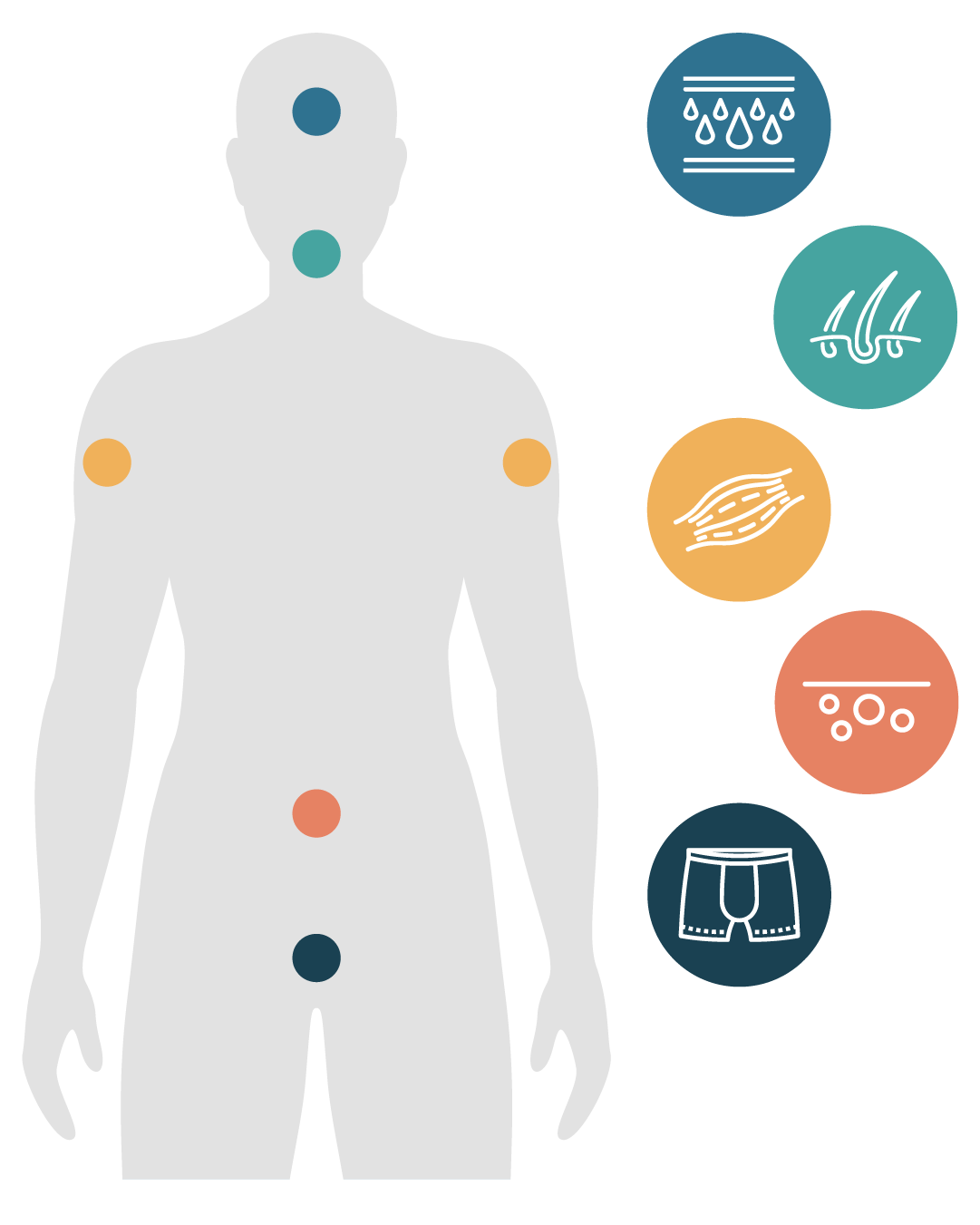
Skin Changes
Skin oiliness/acne
Reversibility: Reversible
Expected Onset: 1 - 6 months
Expected Max. Effect: 1 - 2 years
Skin Changes
Skin oiliness/acne
Reversibility: Reversible
Expected Onset: 1 - 6 months
Expected Max. Effect: 1 - 2 years
Hair Changes
Facial hair grows and body hair thickens.
Reversibility: Irreversible
Expected Onset: 3 - 6 months
Expected Max. Effect: 4 - 5 years
Scalp hair loss. Highly dependant on age and inheritance; may be minimal.
Reversibility: Irreversible
Expected Onset: 6 - 12 months
Expected Max. Effect: Variable
Hair Changes
Facial hair grows and body hair thickens.
Reversibility: Irreversible
Expected Onset: 3 - 6 months
Expected Max. Effect: 4 - 5 years
Scalp hair loss. Highly dependant on age and inheritance; may be minimal.
Reversibility: Irreversible
Expected Onset: 6 - 12 months
Expected Max. Effect: Variable
Increased Muscle Mass and Strength
Increase in muscle mass and strength; significantly dependent on amount of exercise.
Reversibility: Reversible
Expected Onset: 6 - 12 months
Expected Max. Effect: 2–5 years
Increased Muscle Mass and Strength
Increase in muscle mass and strength; significantly dependent on amount of exercise.
Reversibility: Reversible
Expected Onset: 6 - 12 months
Expected Max. Effect: 2–5 years
Increased Muscle Mass and Strength
Increase in muscle mass and strength; significantly dependent on amount of exercise.
Reversibility: Reversible
Expected Onset: 6 - 12 months
Expected Max. Effect: 2–5 years
Body Fat Redistribution
Fat redistributes from buttock, hip and thigh regions to the abdomen and mid-section.
Reversibility: Reversible/Variable
Expected Onset: 1 - 6 months
Expected Max. Effect: 2 - 5 years
Body Fat Redistribution
Fat redistributes from buttock, hip and thigh regions to the abdomen and mid-section.
Reversibility: Reversible/Variable
Expected Onset: 1 - 6 months
Expected Max. Effect: 2 - 5 years
Reproductive and Sexual Health
Clitoral Enlargement
Reversibility: Irreversible
Expected Onset: 3–6 months
Expected Max. Effect: 1–2 years
Vaginal Atrophy
Reversibility: Reversible
Expected Onset: 1–6 months
Expected Max. Effect: 1–2 years
Infertility
Reversibility: Variable
Expected Onset: Variable
Expected Max. Effect: Variable
Reproductive and Sexual Health
Clitoral Enlargement
Reversibility: Irreversible
Expected Onset: 3–6 months
Expected Max. Effect: 1–2 years
Vaginal Atrophy
Reversibility: Reversible
Expected Onset: 1–6 months
Expected Max. Effect: 1–2 years
Infertility
Reversibility: Variable
Expected Onset: Variable
Expected Max. Effect: Variable
Risk Mitigation
Pre-existing medical conditions and risk factors may impart increased risks with testosterone administration and should be considered in order to enable individualized discussions with patients regarding the risks and benefits of treatment. Available measures to reduce associated risks should be considered and discussed with patients and if possible, undertaken prior to or concurrently with the initiation of hormone therapy.
Contraindications
- Pregnancy or breast feeding
- Active sex hormone-sensitive cancer (e.g., breast, endometrial)
- Unstable ischemic cardiovascular disease
- Poorly controlled psychosis or acute homicidality
- Psychiatric conditions which limit the ability to provide informed consent
- Hypersensitivity to one of the components of the formulation
Harm Reduction
In many cases, denying access to hormones can do much more harm than the possible risk of treatment. With an informed consent approach (support, information, education and consent) many providers will initiate hormones with individuals with higher risk profiles when it increases their quality of life/chance survival greatly.
Neurologic
|
Risk Factors
|
How to Minimize Risks
|
|
|---|---|---|
|
Migraines |
Consider daily migraine prophylaxis, consider transdermal route of administration |
|
|
Androgen-sensitive epilepsy |
|
Endocrine
For more information on metabolic risk factors, consult the Guidelines.
|
Risk Factors
|
How to Minimize Risks
|
|---|---|
|
Uncontrolled diabetes |
Identify and address barriers to optimal glycemic control, refer to dietitian, encourage lifestyle modification, initiate antiglycemic agent(s) per national guidelines, consider endocrinology referral, consider cardiac stress test, consider low dose/slow titration with monitoring |
|
Uncontrolled dyslipidemia |
Identify and address barriers to optimal lipid control, refer to dietitian, initiate anti-lipemic pharmacologic therapy per national guidelines, consider endocrinology referral, consider cardiac stress test, consider low dose/slow titration with monitoring |
Cardiovascular
Precautions in red impart moderate to high risk of an adverse outcome without risk mitigation. For more information on cardiovascular disease and related metabolic risk factors, consult the Guidelines.
|
Risk Factors
|
How to Minimize Risks
|
|---|---|
|
Stable ischemic cardiovascular disease |
Consider referral to cardiology, ensure optimal medical (including prophylactic anti-platelet agent(s) if indicated per national guidelines) and/or surgical management as indicated, risk factor optimization, consider transdermal route of administration, and/or low dose/slow titration with monitoring |
|
Uncontrolled high blood pressure |
Identify and address barriers to optimal BP control, initiate antihypertensive(s) as needed, consider cardiac stress test, consider low dose/slow titration with monitoring, consider referral to cardiology |
Hepatic
Elevation of liver enzymes may occur with testosterone therapy. For more information on hepatic dysfunction, consult the Guidelines.
|
Risk Factors
|
How to Minimize Risks
|
|---|---|
|
Hepatic dysfunction |
Dependent on etiology, e.g., minimize alcohol consumption, weight loss in NAFLD, consider referral to hepatology/GI, consider low dose/slow titration with monitoring |
|
Hepatitis C |
Screen patients who are at risk and treat as per current national guidelines. Keep in mind: Infection is not a contraindication to hormone therapy nor is hormone therapy a contraindication to treatment. |
Gynaecologic
For more information on vaginal bleeding and endometrial cancer, consult the Guidelines.
|
Risk Factors
|
How to Minimize Risks
|
|---|---|
|
Inter-menstrual bleeding |
Work up per national guidelines; gynaecology referral as needed |
|
Oligo-/amenorrhea |
Consider pelvic ultrasound (transvaginal, if possible); consider progesterone-induced menstrual bleed prior to testosterone initiation |
Hematologic
|
Risk Factors
|
How to Minimize Risks
|
|---|---|
|
Polycythemia |
Identify etiology and address contributing factors, consider referral to hematology, consider transdermal route of administration, and/or low dose/slow titration with monitoring |
|
History of deep vein thrombosis (DVT), pulmonary embolism (PE) or hypercoagulable state |
Identify and minimize existent risk factors, prophylactic anti-platelet agent(s) if indicated per current national guidelines, consider referral to hematology/thrombosis clinic, use transdermal route of administration +/- lower dose, consider spironolactone as preferred anti-androgen |
|
Strong family history of abnormal clotting |
Rule out genetic clotting disorder, consider transdermal route of administration, consider spironolactone as preferred anti-androgen |
Respiratory
|
Risk Factors
|
How to Minimize Risks
|
|---|---|
|
Smoker |
Encourage and support smoking cessation, consider referral to smoking cessation program/offer NRT and/or bupropion/varenicline, or negotiate a decrease in smoking, consider cardiac stress test. In the presence of additional thrombotic risk factors, consider transdermal route of administration |
|
Chronic respiratory disease that may be worsened by erythrocytosis/polycythemia |
Consider transdermal route of administration, and/or low dose/slow titration with monitoring; consider referral to respirology |
|
Severe/uncontrolled sleep apnea |
Initiate CPAP or oral device, refer to dietitian/encourage lifestyle changes if overweight, monitor for changes in CPAP pressure requirements |
Immunologic
For more information on HIV, consult the Guidelines.
|
Risk Factors
|
How to Minimize Risks
|
|---|---|
|
Autoimmune conditions (e.g., RA, MS, IBD) |
Start low dose, titrate slowly in collaboration with any involved specialists |
|
HIV |
Screen patients who are at risk and treat as per current national guidelines, pay particular attention to CVD and osteoporosis risk reduction; consider use of PrEP in HIV negative patients who are at risk |
Monitoring Strategies
Standard monitoring of testosterone administration should be employed at baseline, and at 3, 6, and 12 months following initiation. Some clinicians prefer to see patients monthly until an effective dose is established. Follow up visits should include a functional inquiry, targeted physical exam, blood work, and health promotion/disease prevention counselling as indicated.
Titration of doses will generally occur in the early phases of treatment. For example, with injectable testosterone, a starting dose of 30 mg injected weekly could be increased by 10-20 mg every 4-6 weeks. Speed of titration will depend on lab results, patient goals, response, and side effects. There may be utility in varying the timing of blood work to gather information regarding serum levels throughout the cycle (peak, mid-cycle and trough), especially if a patient is reporting cyclic symptoms.
Some patients will intentionally seek testosterone levels mid-way between the male and female range. For patients seeking maximum masculinization, the target dose will bring the testosterone level into the physiologic male range. Once the midpoint of the male reference range is attained, additional benefit is questionable. Supraphysiologic levels should be avoided due to the increased risk of adverse events and side effects, as well the potential for the aromatization of excess testosterone into estrogen. Dose reduction is warranted if supraphysiologic doses are measured at mid-cycle or trough. There may be some irregular bleeding or spotting in the first few months of treatment. However, once sustained menstrual cessation is achieved, any vaginal bleeding without explanation (e.g., missed dose(s) or lowered dose of testosterone) warrants a full workup for endometrial hyperplasia/cancer.
When interpreting lab results, clinical effects are the goal of therapy, not specific lab values. Reference ranges will refer to the sex assigned at birth if the sex marker associated with the patient’s health card has not been changed. As reference ranges vary between laboratories, always refer to the ranges from the specific laboratory (often available online or by request). See Appendix J: Reference Ranges (Lifelabs).
Long-Term Preventive Care
Transmasculine patients maintained on masculinizing hormone therapy have unique preventive care needs. Their long-term care should involve at least annual preventive care visits. A Preventive Care Checklist with accompanying explanations for trans-specific recommendations is available below.
Ensuring Patient Comfort in Clinical Encounters
Physical exams involving intimate body parts are uncomfortable for anyone, but trans and non-binary patients may need a slightly different approach in some areas of primary care—including disease prevention and screening. Reflecting on our approach to these encounters (e.g., consider offering to use a side-lying rather than lithotomy position when doing a Pap test with transmasculine individuals) helps provide a more comfortable, gender-affirming experience.
Provide Care Based on Organs Present
It is best to base routine screening on the presence or absence of body parts. Refrain from calling body parts ‘male’ or ‘female’. Instead use non-gendered terms or ask the patient what they prefer to call their body parts. Organs present should receive routine preventive care.

Osteoporosis and Bone Mineral Density Screening
Indications for Bone Mineral Density (BMD) Screening
- All patients over 65 years old
- Patients 50-64 years old at higher risk for osteoporosis (e.g., smoking history, HIV+, high alcohol intake, body weight under 60 kg)
- Consider before 50 years in:
- Certain high-risk conditions such as hyperparathyroidism or malabsorption syndrome
- atients who have undergone oophorectomy and have been on low-dose or no exogenous testosterone for any significant length of time (>2 years)
- Patients post-oophorectomy with elevated LH levels
- Patients who have been on a GnRH analogue for a significant length of time (2 years) without co-administration of exogenous testosterone
- All transmasculine patients should ensure a daily intake of 1000 IU vitamin D and 1200 mg of calcium (total of diet + supplements)
- Gradual weight-bearing exercise should also be encouraged (this could include walking and low-impact aerobic exercise)
Keep in mind that there are no studies to guide the interpretation of BMD results and fracture risk in trans people, including whether to use sex assigned at birth or affirmed gender. One option is to interpret results in comparison to both cis men and cis women; frequency of BMD screening will depend on the results of the initial scan.

Breast/Chest Health
A note on language: some transmasculine patients may prefer to use the term chest over breast(s).
Without top surgery/chest reconstruction
Transmasculine patients who have not undergone chest reconstruction should follow the same breast/chest cancer screening guidelines as for cis women. As with cis women, some transmasculine patients may be at higher risk based on factors such as genetic mutations, family history and prior radiation exposure.
Following top surgery/chest reconstruction
Transmasculine patients who have undergone chest reconstruction likely experience significant risk reduction as there is much less tissue present. However, residual breast tissue does remain, particularly in the axillary regions. Mammography may not be possible following chest reconstruction; ultrasound or MRI may be considered as alternate modalities for screening in patients with significant risk factors (or if an abnormality is detected on exam).
Keep in mind, Transmasculine patients who have a male gender marker on their health card will not be able to self-refer to the Ontario Breast Screening Program; a requisition is required in this case.
Recommendations for patients at average risk of developing breast cancer are visualized in this diagram.

Colon Cancer Screening
Screening guidelines for transmasculine patients are no different than for cis populations. Please follow your local screening guidelines (e.g., Cancer Care Ontario for Ontario guidelines).

Cervical Cancer Screening
In patients without a cervix, cervical screening is generally not necessary; follow guidelines for cis women. Note: Total hysterectomy (removal of uterus and cervix) is performed prior to closure/removal of the vagina (as is commonly done with with metoidioplasty or phalloplasty). Such patients would be unable to under go vault/cuff smear.
If the patient has a cervix, screening depends on age and sexual activity. Follow guidelines as for cis women.
- Patients with a cervix who are younger than 21 or older than 69 do not require screening.
- Patients with a cervix who are 21 to 69 years of age should be screened based on sexual activity:
- If not sexually active, screening is not required. Note that those who become sexually active after age 21 should have their first Pap test within three years of doing so.
- If sexually active, they should receive a Pap test every three years.
Additional Considerations
- Gauge your patient’s comfort with the exam. Some, but not all, transmasculine patients may feel uncomfortable with the idea of penetration and may feel their gender is undermined by the function of the speculum. It may be helpful to explain why a speculum is needed.
- Ask if the patient has had a Pap test before, or whether they have had vaginally penetrative/frontal sex. If the patient has no experience with penetration, it may be helpful to know this in advance and to suggest that they try penetration at home first using a small toy, fingers or a speculum. This may help make the screening process less confusing or disturbing. Some transmasculine patients may be willing to try this, while others will not.
- Some transmasculine patients who are taking testosterone will have fewer secretions, so using lubrication and warm water can be helpful in speculum insertion. Barring contraindications, topical 2% lidocaine jelly may be applied vaginally 5-10 minutes prior to the procedure in those who find speculum examination painful due to atrophic changes.6
- Testosterone can cause cervical cell changes that may make the sample more difficult to read. If the patient is on testosterone, note this on the requisition.6
- Inadequate samples are common in patients on testosterone.7 The use of both brush and broom may increase yield in patients with atrophic changes.8
- HPV vaccine should be offered to patients under age 45.

Ovarian Cancer
Analogous to concerns of an increased risk of ovarian cancer in cis women with elevated androgen levels, it has been postulated that testosterone therapy in transmasculine patients may increase risk. There have been a few cases of ovarian cancer in transgender men. Overall there is no evidence to suggest an increased risk of ovarian cancer in transmasculine patients on testosterone, and thus no cause to perform oophorectomy in transmasculine patients solely for purposes of primary prevention.
